Award-Winning Gas Line Installation and Repair Across Anaheim, California
Licensed, permitted, pressure-tested — because gas work leaves no room for shortcuts
Gas is the one system in your home where a mistake isn't a leak under the cabinet — it's a fire or an explosion. Resort Anah Plumbing has spent 35+ years running and repairing Anaheim's gas lines, and every job is permitted, sized to the appliance load, bonded where CSST requires it, and pressure-tested before a single joint is concealed. That discipline isn't optional on gas. It's the whole job.
C-36 Licensed Contractor
California Contractors State License Board — licensed gas line specialists for Anaheim and all of Orange County.
Gas Line Specialists
Electronic leak detection, repair, repiping, and new appliance gas lines — every service, done right.
Permitted & Pressure-Tested
Every gas job — permit pulled, California Plumbing Code Chapter 12 followed, pressure-tested to 10 psi minimum before any joint is concealed.
Award-Winning Service
PHCC Contractor of the Year · Readers' Choice Best Plumber · Neighborhood Fave Award · Robert M. Cox Image Awards — recognized across Anaheim and Orange County.
50 Professionals, 10 Vans
50 skilled professionals and 10 fully equipped service vans dispatched 24/7 across Anaheim and surrounding cities.
Five Active Insurance Policies
General liability, workers' compensation, professional liability, commercial auto, and tools & equipment insurance — full coverage on every job.
Gas Line Installation Services for Homes and Businesses Near Anaheim's Landmarks and Dining Corridors
From Colony bungalows to Anaheim Hills outdoor kitchens
The gas line under a 1920s Craftsman near the Mother Colony House is likely aging black iron, threaded decades ago and quietly corroding. The homes in Anaheim Hills want new lines run to pool heaters, fire pits, and outdoor kitchens. Restaurants in the Anaheim Packing House and along Center Street Promenade run commercial gas loads that dwarf a house. And all of it sits in seismically active Southern California, where an earthquake shutoff valve is a conversation worth having. Same fuel. Very different lines.
Historic & Older Homes
Anaheim Colony Historic District, Five Points, Hoskins, Historic Palm District, Mother Colony House vicinity — aging black iron piping that needs inspection and likely replacement.
Postwar Tract Homes
West Anaheim, Northwest Anaheim, corridors along Ball, Lincoln, Euclid, and Brookhurst — mid-century piping sized for a 1960s appliance load, often undersized for today's tankless water heaters and modern ranges.
Hillside & Custom Homes
Anaheim Hills, Peralta Hills, Mohler Loop — outdoor kitchens, pool heaters, fire pits, and standby generators requiring new trenched gas lines sized to high-BTU loads.
Multifamily & Mixed-Use
Platinum Triangle, The Colony lofts, Angel Stadium and Honda Center corridors — multifamily gas systems, shared risers, and the permit coordination that comes with them.
Commercial Gas Service
Anaheim Packing District, Center Street Promenade, Little Arabia, Downtown Disney District, Anaheim Resort District hotels, Anaheim Canyon — commercial gas piping for kitchens, boilers, and large-scale appliances that far exceed residential loads.
Anaheim's Gas Line Specialists — The One Job You Never Hand a Handyman
Licensed, permitted, sized correctly, and pressure-tested every time
Water leaks damage a cabinet. Gas leaks damage a city block. That difference is why gas work is licensed, permitted, and inspected in a way that ordinary plumbing isn't — and why an undersized line, a missing bond, or an untested joint isn't a callback, it's a hazard. We treat every gas line as what it is: a system where the margin for error is zero.
- Electronic gas leak detection to pinpoint the source, not guess at it
- Correct pipe sizing to the total appliance BTU load — undersized lines starve appliances and run unsafe
- CSST bonding to the grounding electrode system, a lightning-safety step many installs skip
- Shutoff valve at every appliance, in the same room, per the California Plumbing Code
- Mandatory pressure test before any joint is concealed or gas is restored
Why Gas Work Is Different
A water leak is an inconvenience. A gas leak is an emergency. Every connection, joint, and run is life-safety critical — which is why California requires a licensed contractor, a permit, and a pressure test on every gas piping job.
When Does a Gas Smell Mean You Need Emergency Gas Line Repair in Anaheim?
The signs that separate an urgent call from a scheduled one
A gas leak is never a "watch and see" problem. Some signs mean evacuate and call the utility this second; others mean call a plumber this week before a corroding line becomes a leak. Knowing which is which matters, and in Anaheim's older homes, aging black iron pipe is often the reason a line that was fine for forty years suddenly isn't.
Rotten-Egg or Sulfur Smell
Evacuate immediately, call SoCalGas at 1-800-427-2200, then call us. Natural gas is odorized so you can detect a leak — if you smell it, leave.
Hissing or Whistling Sound
A hissing or whistling sound near a gas line or appliance — a leak under pressure. Treat it as urgent and call immediately.
Dead Grass or Blowing Dirt
A dead patch of grass or dirt blowing up near a buried line — a possible underground leak. Call for leak detection before it escalates.
Gas Bill Climbing Unexplainably
A gas bill climbing with no change in usage — a slow leak somewhere in the system that's wasting fuel and posing a safety risk.
Corrosion, Rust, or Pitting
Visible corrosion, rust, or pitting on exposed gas pipe — the line is deteriorating and needs replacement before it leaks.
Weak Flames or Appliances Won't Stay Lit
Appliances that won't stay lit or burn with a weak flame — often an undersized or partially blocked line. Common in Anaheim's older homes feeding modern appliances.
Adding a High-Demand Appliance
Adding a pool heater, generator, or tankless water heater may exceed your existing gas line and meter capacity — assess before you buy.
Who Our Gas Line Repair and Replacement Service Is For
Homeowners, restaurateurs, property managers, and facility teams
We serve everyone from a homeowner adding a gas range to a Resort District hotel running a commercial kitchen. Because the customer owns everything downstream of the meter, gas line repair and new line installation is a property-owner responsibility — and one we handle end to end, permit to pressure test.
Homeowners with Leaks or Aging Pipe
Homeowners in Anaheim Hills, West Anaheim, and The Colony with leaks, aging pipe, or new appliances that need gas service.
Gas Amenity Additions
Homeowners adding pool and spa heaters, fire pits, outdoor kitchens, and standby generators — our most common Anaheim Hills gas line projects.
Restaurants & Commercial Kitchens
Restaurants and commercial kitchens in the Packing District and Resort District needing commercial gas lines sized to large-scale loads.
Landlords & Property Managers
Landlords and property managers maintaining aging gas systems across multifamily portfolios — scheduled replacement, not emergency callbacks.
Buyers & Sellers
Buyers and sellers who need a gas line inspected, repaired, or brought to code before close — documentation for escrow and insurance.
Electric-to-Gas Conversions
Anyone converting from electric to gas — ranges, dryers, and water heaters that need a new gas line run from the meter.
Gas Leak Emergency
Anyone who smells gas and needs a licensed plumber after SoCalGas has made the site safe — we respond 24/7 for the repair the utility doesn't perform.
Anaheim Housing Stock
Most of Anaheim's gas piping is aging black iron threaded together generations ago — corroding internally, externally, and stressed by decades of seismic activity.
Schedule a Gas Line AssessmentHow Anaheim's Aging Housing Stock and Soil Threaten Gas Lines
The local conditions working against your gas piping
Roughly 72% of Anaheim was built between 1950 and 1979, which means much of the city's gas piping is aging black iron threaded together generations ago. Across northern Orange County, that older steel pipe corrodes from the inside and the outside, especially where it runs underground through the region's clay-heavy, moisture-holding soil. Add Southern California's seismic activity, which stresses rigid pipe joints over decades, and you get a predictable set of failure points.
- Internal corrosion of old black iron — decades of use scale and pit the pipe wall from within
- External corrosion on buried steel lines — Anaheim's clay soil holds moisture against uncoated pipe
- Stressed and loosened joints — seismic movement works threaded connections loose over time
- Undersized legacy lines — piping sized for a 1960s appliance load can't safely feed a modern tankless unit or pool heater
- Failing appliance connectors — old semi-rigid aluminum or copper connectors that SoCalGas recommends replacing
- Unbonded CSST — flexible tubing installed without proper bonding is a lightning-strike hazard
Gas Leak Repair, New Lines, and Repiping: What Gas Line Work Actually Covers
Different jobs, different materials, one non-negotiable standard
"Gas line work" spans a two-foot appliance connection and a hundred-foot trenched run to a pool heater. What they share is a licensed, permitted, pressure-tested standard. Here's what we actually do, and what each job involves.
| Service | Typical Use | What's Involved |
|---|---|---|
| Gas Leak Detection & Repair | Suspected or confirmed leak | Electronic detection, locate the source, repair or replace the section, pressure re-test |
| New Appliance Line | Range, dryer, water heater | Branch from existing line, sized to BTU load, shutoff valve, sediment trap |
| Pool / Spa Heater Line | Backyard heater | Often trenched underground; higher BTU load; weatherproofed connection |
| Outdoor Kitchen / Fire Pit | Anaheim Hills patios | Buried run, multiple outlets, code-compliant outdoor materials |
| Standby Generator Line | Whole-home backup | High CFH demand; frequently needs a meter upgrade with SoCalGas |
| Gas Repiping | Old, corroded systems | Replace aging black iron throughout; modern materials; full re-test |
| CSST Installation & Bonding | Flexible modern piping | Certified-installer tubing, bonded to the grounding electrode system |
| Commercial Gas Piping | Restaurants, hotels | Larger loads, commercial appliances, coordinated inspection |
Approved Materials & Code Requirements
- Approved materials: Schedule 40 black or galvanized steel, wrought iron, and CSST (certified installer only)
- Buried exterior runs use PE pipe, at code-required depth with proper cover
- CSST must be bonded to the grounding electrode system with a jumper no smaller than 6 AWG copper
- Every appliance gets a shutoff valve in the same room, within 3 feet, per the California Plumbing Code
Our 6-Step Gas Line Repair and Replacement Process in Anaheim, CA
From leak detection to a passed pressure test
Gas Leak Detection & System Assessment
We locate the problem with electronic gas detection rather than guesswork, inspect the exposed piping and appliance connections, and assess the age, material, and condition of the system. You get a clear picture of whether it's a single repair or an aging system that needs repiping.
Load Calculation, Scope & Written Estimate
For new lines, we calculate the total BTU load and size the pipe to feed every appliance safely — most legacy lines we find are undersized for modern appliances. Then a written, line-item estimate before any work begins.
Permitting & Orange County Code Compliance
Gas work requires a permit, full stop. Across Orange County, we pull the City of Anaheim permit, submit the piping diagram and BTU loads, and follow the California Plumbing Code's Chapter 12 requirements — including the shutoff valve at every appliance and, where a seismic gas shutoff valve is required or elected, a DSA-certified valve installed correctly.
Line Repair, Replacement, or New Installation
We repair the failed section, replace corroded runs, or install the new line — using approved materials, correct pipe support, proper depth and coating on buried runs, and CSST bonded to the grounding electrode system where flexible tubing is used.
Pressure Testing & Leak Verification
Before any joint is concealed or gas is restored, we pressure-test the system — pressurized to at least 10 psi and held for at least 15 minutes with no perceptible drop on a calibrated gauge — and verify every connection with a manometer and leak-detection solution.
Inspection, Gas Restoration & Documentation
We coordinate the City inspection, and because only SoCalGas may turn gas back on at the meter, we coordinate that restoration and confirm every appliance relights and runs safely. Then you get the documentation — permit close-out, test results, and what was done.
What's Included in Our Gas Line Repair and Replacement Service
Detection, permitted work, pressure testing, and safe restoration
Gas work has no acceptable shortcuts. Our scope covers every step that keeps the job safe and legal — the permit, the sizing, the bonding, the test, and the coordinated restoration.
Anaheim's Trusted Gas Line Repair Team
Fast response, correct sizing, and paperwork that holds
When you compare gas line contractors in Anaheim, the difference isn't who owns a pipe threader. It's who pulls the permit, who sizes the line to the real load, who bonds the CSST, and who pressure-tests before they close a wall.
- 35+ years serving Anaheim and northern Orange County — established 1990
- 50 in-house professionals and 10 fully equipped vans, with 24/7 emergency dispatch
- Electronic gas leak detection and full pressure testing on every job
- Adjacent expertise: water heaters, tankless units, boilers, and pool heater lines
- Permitted and documented — inspection-ready, insurance-ready, escrow-ready
Before & After Gas Line Repair and Replacement in Anaheim, CA
The corrosion you can't see, and the line that replaced it
Our before-and-after documentation shows what a gas line looks like before it fails. Corroded, pitted black iron pulled out of a West Anaheim tract home and replaced with correctly sized modern pipe. An undersized legacy line that couldn't feed a new tankless water heater, upsized to carry the load. Unbonded CSST bonded to code. And the pressure gauge, holding steady, before anything got covered.
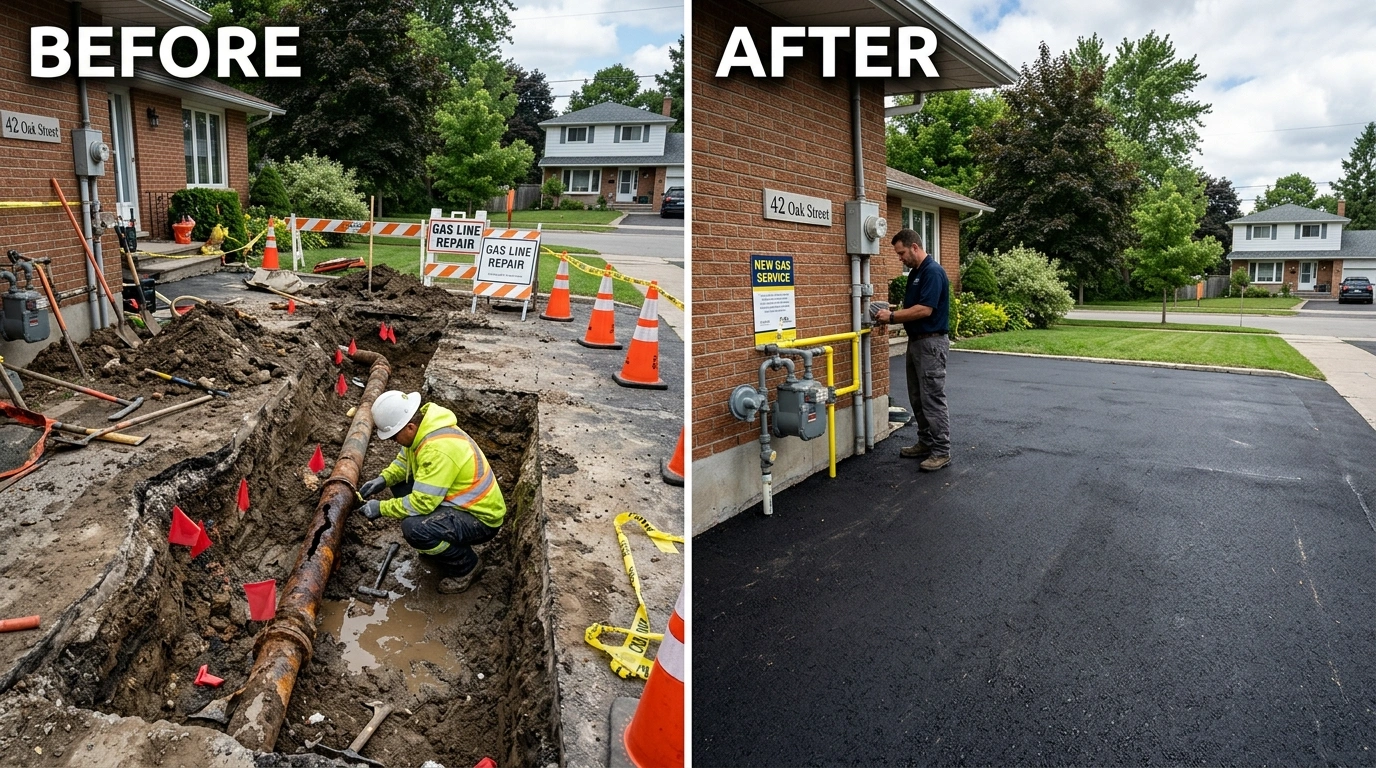
- Corroded black iron lines replaced with correctly sized, code-compliant piping
- Undersized legacy lines upsized to feed modern high-BTU appliances
- Unbonded CSST corrected with proper grounding-electrode bonding
- Aging aluminum appliance connectors replaced with approved flexible connectors
- New trenched lines run to pool heaters, outdoor kitchens, and standby generators
Gas Line Materials and Methods We Use in Anaheim
Approved materials, code-compliant methods, tested every time
Every gas line we install meets the same standard — a two-foot range connection in a Platinum Triangle condo or a hundred-foot trenched run to an Anaheim Hills pool heater. On gas, the method is the safety.
Schedule 40 Steel & Wrought Iron
Black or galvanized steel and wrought iron for rigid piping, correctly sized to the BTU load of every appliance on the line.
CSST — Certified & Bonded
Corrugated stainless steel tubing installed by certified installers, bonded to the grounding electrode system with 6 AWG copper minimum.
PE Pipe for Buried Runs
Polyethylene pipe for buried exterior runs, at code-required depth with corrosion-resistant coating and proper cover.
Gas-Rated Sealant
Gas-rated sealant on threaded joints — never water-service PTFE tape, which degrades in gas applications.
Shutoff Valves & Sediment Traps
Shutoff valves and sediment traps at every appliance, per the California Plumbing Code — so each appliance can be safely isolated.
Electronic Detection & Pressure Testing
Electronic leak detection and manometer testing to verify system integrity before gas is ever restored.
Coordinated SoCalGas Restoration
Because only the utility may turn gas on at the meter, we coordinate restoration and verify every appliance relights safely.
Gas Line Repair vs Replacement: Which Does Your Anaheim Property Need?
When a section repair is enough, and when the system needs repiping
A single leak at a fitting or a damaged section is often a straightforward repair. But when corroded black iron is leaking in one spot, it's usually deteriorating everywhere, and a natural gas line installation to repipe the system is the safer, more economical long-term answer than chasing leak after leak. We assess the whole system, not just the spot that failed, and tell you honestly which one you're facing.
| Option | What It Is | Key Pros | Key Cons |
|---|---|---|---|
| Section Repair | Fix or replace the failed segment | Fast, lower cost; restores service quickly | Doesn't address aging pipe elsewhere in the system |
| Appliance Connector Replacement | Replace old flex connectors | Inexpensive; removes a common failure point | Only addresses the connection, not the line |
| Line Upsizing | Replace an undersized run | Feeds modern high-BTU appliances safely | Larger scope than a simple repair |
| Full Repipe | Replace aging gas piping throughout | Ends recurring leaks; modern materials; long-term safety | Highest upfront cost; permits and testing required |
When Repiping Is the Right Call
- Corroded black iron is leaking, which usually means it's failing system-wide
- Multiple leaks have appeared over a short period
- The system is undersized for the appliances the home now runs
- Old semi-rigid aluminum or copper connectors are throughout the home
- You're renovating and the walls are open — perfect timing for a remodel
- An inspection flagged the gas system before a sale
How Much Does Gas Line Repair and Replacement Cost in Anaheim, CA?
From a single appliance branch to a full repipe
Nationally, interior gas line runs $15 to $25 per linear foot for simple routes and $35 to $50+ for complex, underground, or multi-turn runs, with a typical new appliance branch landing at $400 to $1,500 and most residential projects between $600 and $2,200. Leak repair averages around $310 to $600, more where a buried line must be excavated. Running a new service line from the street runs $2,000 to $10,000+. Orange County labor sits above the national mean, and one factor catches people off guard: high-demand appliances often exceed the meter.
Main Cost Drivers
- Length of the run and how accessible the route is
- Interior vs buried exterior line (trenching and restoration add cost)
- Pipe material and the appliance's BTU load
- Whether the meter must be upgraded for a high-demand appliance
- Leak repair complexity — exposed pipe vs excavated buried line
- Seismic gas shutoff valve, where required or elected
- Permit, inspection, and pressure-test — always included in a legitimate job
| Service | Typical Anaheim Range |
|---|---|
| Gas leak detection & diagnosis | ~$150 – $450 |
| Gas leak repair (exposed pipe) | ~$200 – $700 |
| Gas leak repair (buried / excavated) | ~$800 – $2,500+ |
| New appliance line (range, dryer, water heater) | ~$400 – $1,500 |
| Gas line to pool / spa heater | ~$800 – $2,500+ |
| Gas line to outdoor kitchen / fire pit | ~$900 – $3,000+ |
| Standby generator line | ~$1,000 – $3,500+ |
| Whole-home gas repipe | ~$3,500 – $9,000+ |
| Seismic gas shutoff valve (installed) | ~$250 – $700 |
| Cap an unused gas line | ~$75 – $200 |
| SoCalGas meter upgrade coordination | Varies by utility |
| City of Anaheim gas permit | ~$100 – $300 |
Who Needs a Licensed Plumber Instead of a Handyman for Gas Line Work in Anaheim?
The answer, on gas, is always
Unlike most plumbing, gas work has essentially no safe DIY or handyman zone. It requires a permit, correct sizing, proper bonding, a pressure test, and coordination with the utility — and getting any of those wrong risks a fire, an explosion, or carbon monoxide. Here's who specifically needs a licensed gas plumber.
- Anyone with a suspected or confirmed gas leak, after the utility has made the site safe
- Anyone adding or converting a gas appliance — range, dryer, water heater, or tankless
- Anyone adding a high-demand appliance — pool heater, generator, or outdoor kitchen that may need a meter upgrade
- Anyone with aging black iron that's corroding or has started to leak
- Anyone installing CSST, which must be bonded to the grounding electrode system
- Anyone whose property needs a seismic gas shutoff valve under the City's ordinance or by choice
- Anyone buying or selling a home where the gas system needs inspection or repair before close
Never a DIY or Handyman Job
California requires a licensed contractor, a permit, and a passed pressure test on all gas piping work. Unlicensed gas work voids your insurance, fails inspection, and puts lives at risk.
Gas work requires:
- C-36 Licensed Contractor
- City Permit
- Pressure Test
- City Inspection
- Utility Restoration
Benefits of Professional Gas Line Repair and Replacement in Anaheim, CA
Safety, code compliance, and a system you can trust
On gas, the benefit of hiring a licensed professional isn't convenience or a cleaner finish. It's that your home doesn't catch fire, your family isn't exposed to carbon monoxide, and your gas system passes inspection and survives an insurance claim.
Leaks Found & Fixed Correctly
Electronic detection and a verified pressure test, not a guess — every leak located, repaired, and confirmed sealed.
Correct Pipe Sizing
Every appliance fed safely with correctly sized piping — no starved or over-pressured connections that run unsafe.
CSST Bonded to Code
The lightning-safety step that protects against a strike igniting the line — the bonding many installs skip, and we never do.
Permitted & Inspected
Protecting your resale, appraisal, and insurance — documented work that passes city inspection and holds up in escrow.
Safe Utility Coordination
Because only SoCalGas may restore gas at the meter — we coordinate restoration and verify every appliance relights safely.
Seismic Protection
A DSA-certified earthquake valve, correctly mounted — seismic protection where it matters most in Southern California.
Complete Documentation
Documentation for buyers, inspectors, and insurers — permit close-out, test results, and a record of exactly what was done.
Safety Alert: What to Do the Moment You Smell Gas
The steps that save lives — in order
Natural gas is odorized to smell like rotten eggs so you can detect a leak, but odor fade means you can't rely on smell alone. If you smell gas, hear hissing, or see signs of a leak, the response is not to investigate — it's to leave. Do not operate any light switch, appliance, phone, or anything that could spark, because gas escaping from a pipe can generate enough static electricity to ignite itself. Get out, then call from a safe distance.
Gas Line Repair and Replacement FAQs for Anaheim Homeowners
Responsibility, safety, cost, and the questions we answer every week
You are. SoCalGas maintains the gas lines up to and including your meter, but everything on your side of the meter — the piping from the meter to your appliances, from a curbside meter to the home, and underground to a pool heater, barbecue, or other appliance — is customer-owned and your responsibility to maintain and repair. That's exactly the work we do.
Leave the building immediately. From a safe location, call SoCalGas at 1-800-427-2200, and call 911 if there's danger to life or property. Do not light a flame, do not operate any electrical switch or device, and do not try to find or fix the leak yourself — escaping gas can create static electricity that ignites it. Once SoCalGas makes the site safe, call us for the repair.
Interior runs typically cost $15 to $25 per linear foot for simple routes, and a new appliance branch runs $400 to $1,500. Most residential projects land between $600 and $2,200. Leak repair averages $310 to $600 for exposed pipe, more if a buried line must be excavated. A full repipe runs $3,500 to $9,000+. We estimate line by line before any work — request a free quote.
California authorizes them under Health and Safety Code sections 19180–19183, and any valve installed must be certified by the Division of the State Architect. But whether one is required depends on your city's ordinance — some California cities mandate them on new construction, major alterations, or any gas permit, while others don't. Anaheim sits in active earthquake country, so many homeowners install one by choice regardless. We install DSA-certified valves correctly, mounted to the building exterior on your side of the meter, and we can tell you what applies to your property and permit.
Yes, always. Gas piping work requires a permit and inspection in Anaheim, and the work must meet the California Plumbing Code's Chapter 12 requirements. This isn't a formality — it's the process that catches an undersized line, a missing bond, or an untested joint before it becomes a hazard. We pull the permit and coordinate the inspection.
With a pressure test, required before any joint is concealed or gas is restored. The system is pressurized with air, CO₂, or nitrogen to at least 10 psi and held for at least 15 minutes with no perceptible drop on a calibrated gauge, and we verify connections with a manometer and leak-detection solution. Only after it passes do we coordinate restoration.
CSST is corrugated stainless steel tubing — the flexible yellow gas line that installs faster than rigid black iron through walls and joist bays. Because it's thin-walled, a nearby lightning strike can arc to it and puncture it, so code requires CSST to be bonded to the electrical service grounding electrode system with a jumper no smaller than 6 AWG copper. Many installations skip this. We don't.
Yes. These are among our most common Anaheim Hills jobs. They usually involve a trenched underground run at code-required depth, higher BTU loads, and weatherproofed outdoor-rated connections. We size the line to the appliance and confirm your meter can carry the added demand.
It might. A standby generator can draw 200+ CFH, a pool heater around 400 CFH, and a tankless water heater about 200 CFH — and a standard residential meter is often around 250 CFH total. Adding one of these frequently exceeds both the existing line and the meter, requiring an upsized line and a meter upgrade coordinated with SoCalGas. We assess that before you buy the appliance.
Often, yes. A weak flame or an appliance that won't stay lit frequently points to an undersized or partially obstructed gas line that can't deliver enough fuel — common in older Anaheim homes where a 1960s-era line is now feeding modern appliances. We diagnose whether it's the line, the connector, or the appliance.
Yes. Commercial kitchens in the Packing District and Resort District run gas loads far larger than a home, with commercial appliances and their own inspection requirements. We install and repair commercial gas piping, sized and permitted correctly.
Yes, every day of the year. Once SoCalGas has responded to a leak and made the site safe, call us at +1 (657) 842-6744 for the repair — and for damaged lines, failed connections, and gas emergencies where a licensed plumber is needed.
Our Anaheim Gas Line Repair and Replacement Guarantee
Permitted, pressure-tested, and safely restored — every time
Resort Anah Plumbing does not consider a gas job done until it's permitted, sized correctly, bonded where CSST requires it, pressure-tested to code, inspected, and safely restored to service. On gas, we don't cut a single corner, because there isn't one that's safe to cut. If it doesn't hold pressure, it doesn't get covered.
Since 1990, homeowners from the Craftsman bungalows of the Anaheim Colony to the hillside homes above Oak Canyon have trusted Resort Anah Plumbing with the one system in their home where being right is the only acceptable outcome.
From a single appliance hookup to a full-home repipe, Resort Anah Plumbing delivers licensed, permitted, pressure-tested gas line repair and replacement in Anaheim, CA — 24 hours a day, every day of the year.
Gas Line Repair & Replacement — Cities We Serve Near Anaheim
Our gas line repair and replacement services extend across these communities:
Get Emergency Gas Line Services in Anaheim Now
Need a gas line plumber in Anaheim CA? Our 50 skilled professionals are standing by 24/7. Call or fill out the form for a free estimate.
Contact Resort Anah Plumbing
(657) 842-6744
1313 S Harbor Blvd
Anaheim, CA 92802
24/7 Emergency Service Available
Monday – Sunday: 00:00 – 23:59